

Autocatalysts represent the largest end-use for platinum, supported by tightening emissions legislation globally. Platinum is an effective catalyst for the conversion of hydrocarbons and carbon monoxide to harmless compounds, particularly in diesel engines, both light-and heavy-duty. Adding some palladium to the formulation along with the platinum can increase the thermal stability and hence durability of the autocatalyst, helping to ensure that the vehicle complies with emissions standards for its operational lifetime. While battery electric vehicles are competing for market share in light-duty vehicles, heavy-duty diesel vehicles remain important for platinum, though battery electric powertrains can also be successful in some heavy-duty applications.

Platinum wedding rings
Jewellery is the second most important demand segment, currently representing around a fifth of global platinum demand.
Platinum demand 2025
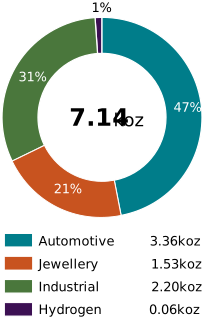
China dominates the market for platinum jewellery, with specific demographic and cultural factors particularly important, especially in the bridal jewellery market. Platinum-based catalysts are also key to many large-scale industrial chemical processes. They ensure high-quality production with fewer by-products and more efficient use of input raw materials, frequently along with lower energy use in the process. Nitric acid and silicone production form the largest industrial demand sectors. The petroleum industry also uses platinum catalysts to help refine fuels such as gasoline from crude oil.
Thanks to the metal’s extreme high temperature stability and purity, platinum tooling is used in the fabrication of specialist glass including display screen glass and glass fibre. Platinum’s biocompatibility and purity make it the material of choice in a variety of medical procedures and implants, as well as in the pharmaceutical industry where platinum-based drug molecules have a strong track record in various cancer treatments.
Many electrical applications also consume platinum, primarily in hard disk drives used for data storage, in automotive sensors for optimising the operation of autocatalysts for better emissions control and in spark plugs to improve fuel efficiency.
Platinum plays an increasingly important role in decarbonisation, as a catalyst across all parts of the hydrogen value chain.
Upstream, platinum is used in electrolysers to produce green hydrogen by splitting water. In the midstream, it is used in several processes for storage and transport of hydrogen and hydrogen carriers, and in production of low-carbon fuels. Downstream, it is used in some fuel cells, where hydrogen is converted to electricity for stationary and mobile applications.
Information above provided by SFA (Oxford)