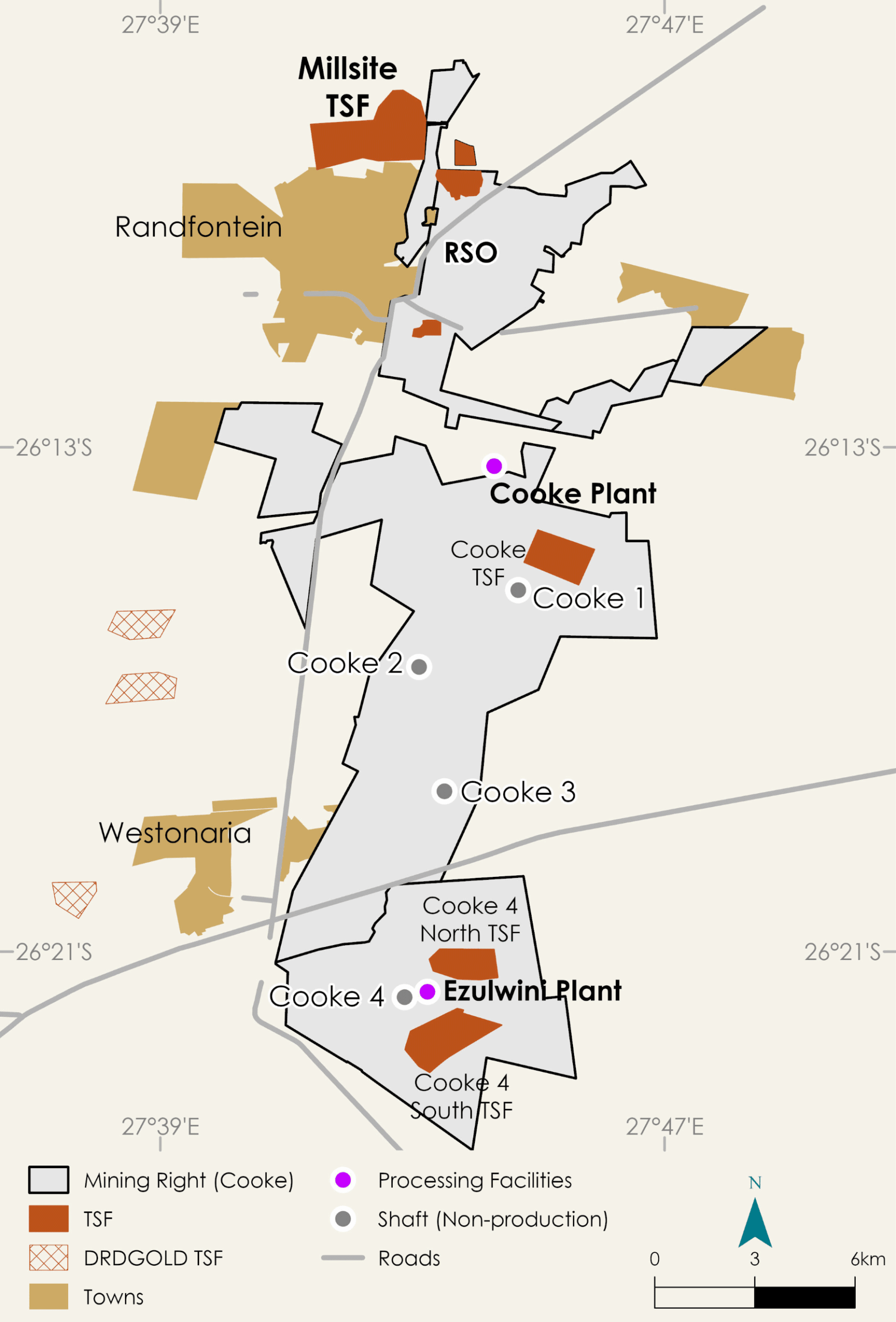

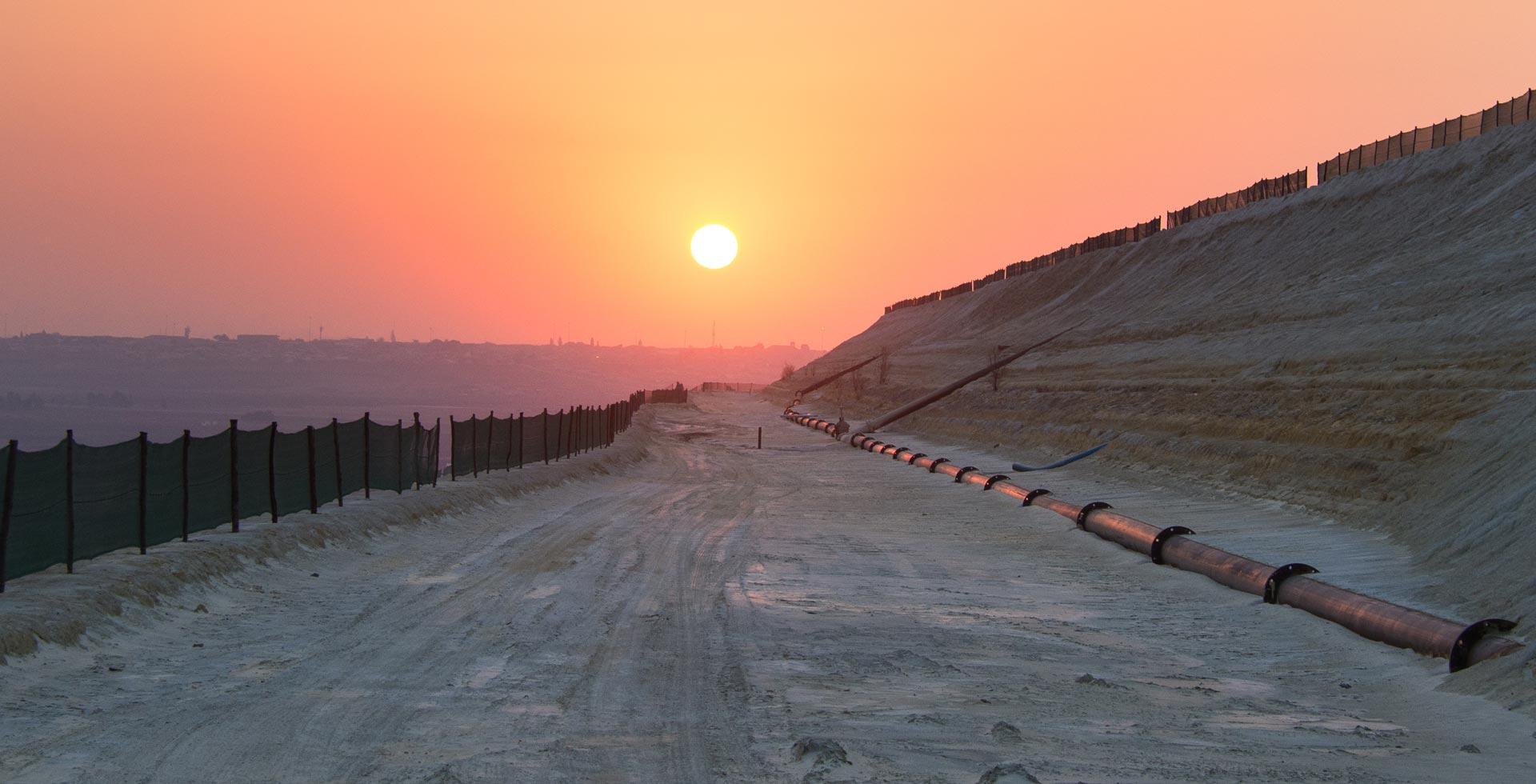
The Cooke operation is situated in the West Wits Line of the Witwatersrand Basin, near the town of Randfontein approximately 35km south-west of Johannesburg, in the Gauteng province of South Africa.
Statistics as at 31 December 2025
Life of mine

Cooke TSF*:
2038
*Tailing storage facility

Gold production
28,743oz

All-in sustaining cost
US$3,296/oz

Workforce
1,014
employees and contractors
For up-to-date quarterly production figures, please refer to the latest results booklet.
Current operations consist of two main facilities: the Randfontein surface operation (RSO), which processes historic tailings through the Cooke gold plant, and the Ezulwini gold plant located at No. 4 shaft. Ezulwini gold plant provides processing services for both third party clients and our own operations.
At 31 December 2025, Cooke had surface gold Mineral Reserves of 0.6Moz and Mineral Resources of 1.7Moz. In addition, it had a uranium Mineral Resource of 32.3Mlb and Mineral Resources of 25.2Mlb.
A closer look
The Rand Surface Operation (RSO) is a mature, established and ongoing reprocessing operation. The mining method is via monitored high-pressure water jets.
The Cooke operation was previously a large underground mining complex, consisting of four vertical production shafts, but the final underground workings were placed on care and maintenance during 2017.
Ezulwini Gold Plant (at No. 4 Shaft) is used as a toll treating facility, catering to both external and other internal operations. At the Ezulwini plant, there is an independent uranium recovery circuit, which is currently on care and maintenance, constructed in the early 2000s.
The Cooke TSF is located near Cooke Plant. A FS into the extraction of contained gold and uranium was completed, which led to the declaration of a maiden Mineral Reserve.
Rand Uranium (Pty) Ltd (a subsidiary of Sibanye Gold (Pty) Ltd) holds a converted mining right over the operations known as Cooke No. 1, No. 2, and No. 3 in terms of the MPRDA, under DMPR reference number: GP30/5/1/2/2/07 MR (Cooke 123 MR), valid from 18 December 2007 to 17 December 2037 and covering a total area of 79.31km².
Rand Uranium (Pty) Ltd also holds a converted mining right over the operation known as Randfontein surface operation (RSO) in terms of the MPRDA, under DMPR reference number: GP30/5/1/2/2/173 MR (RSO MR) valid from 7 May 2009 to 6 May 2039, with a total area of 31.30km².
Ezulwini Mining Company Pty Ltd (a subsidiary of Sibanye Gold Pty Ltd) holds a mining right over the operation known as Cooke No. 4 (Ezulwini), under DMPR reference number: GP30/5/1/2/2/38 MR (Ezulwini MR), valid from 20 November 2006 to 19 November 2036 and covering a total area of 37.18km².
As part of the approved environmental management programme report (EMPR), tailings from Cooke plant are deposited into unrehabilitated open pits connected to the old underground workings of the historic Randfontein Estates Gold Mine. The volumetric depositional capacity available in these pits, which assumes there is no further storage capacity in the connected underground workings, is used to constrain the current 18 month LoM.
Longer term, the exploitation of the remaining surface Mineral Resources are dependent on the establishment of additional depositional capacity, and various alternatives are under consideration.
The FS into the possible extraction of gold and uranium in the Cooke TSF was completed in 2025 resulting in the declaration of a maiden Mineral Reserve. The project envisages the reclamation and re-processing of the dump at a rate of 600ktpm to produce on average 2.3Mlbpa U3O8 and 23.8kozpa gold over a 14-year life.
The Mineral Reserves (1.5 years) of the existing RSO-Millsite tailings retreatment operation are limited by the availability of tailings deposition capacity. The Millsite TSF complex, which is currently being exploited, represents the bulk of the reported Mineral Resources and contains a total of approximately 93.9Mt of attributable Mineral Resources, potentially supporting a twenty year LoM.
The regional TSF being pursued by DRDGOLD, as part of its phase two expansion of the FWGR operation, is one of the alternative depositional solutions being investigated.